
Listen to industry
Practitioners surface the capabilities, workflows, and judgment the field now demands.
BayesStack turns emerging industry capabilities into university ready courses, then equips your faculty to own and deliver them with rigor.
 BAYESSTACK / IN PRACTICE
THE PROGRAM THESIS
Universities already hold the trust, teaching muscle, and long-term relationship with students. Industry holds fast-moving context: which systems matter, how teams work, and where the technical bar is moving.
BayesStack connects the two. We translate practitioner knowledge into an academically legible course, prepare faculty to lead it, and provide the software and delivery support that turns a syllabus into a lived learning experience.
Practitioners surface the capabilities, workflows, and judgment the field now demands.
We structure concepts, credits, lab hours, assessments, rubrics, and prerequisite maps.
Faculty study the subject, rehearse delivery, inspect solutions, and calibrate evaluation.
Studios capture attempts, tests, milestones, feedback and capability, not attendance alone.
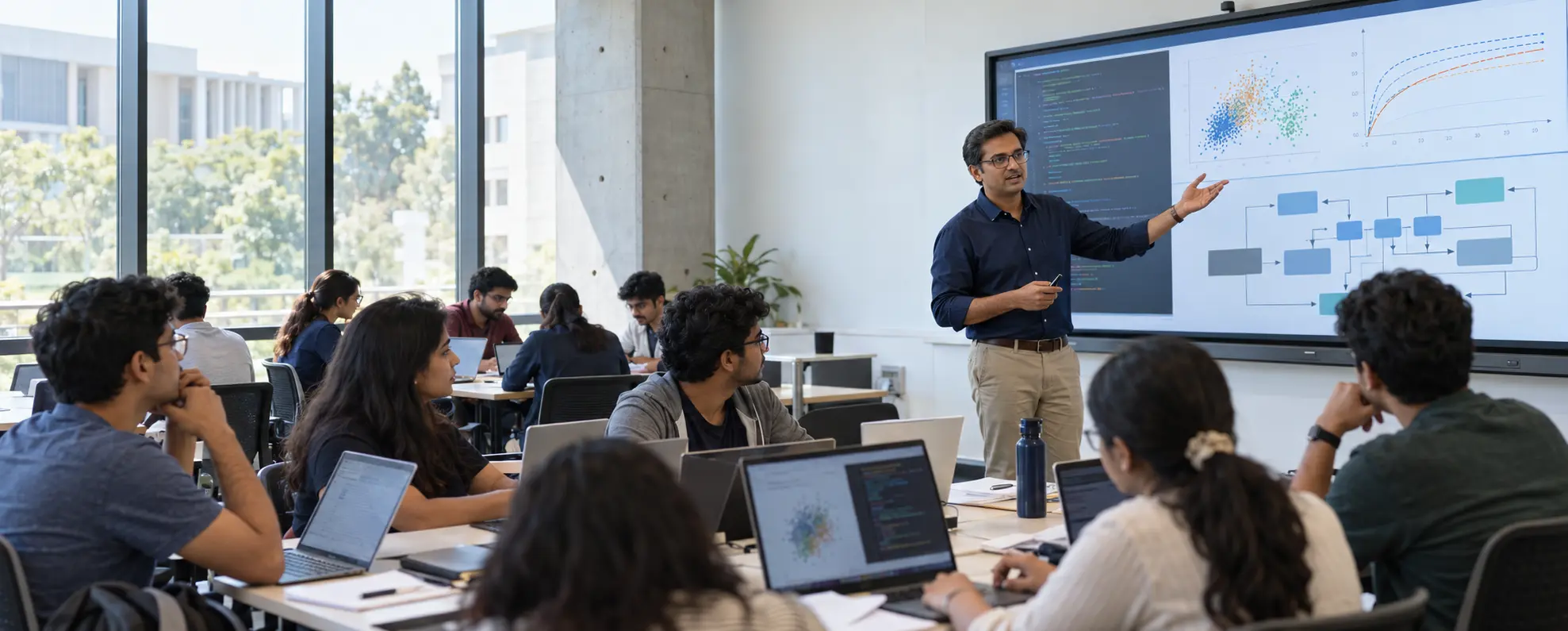
Each concept is delivered through an interface designed around the activity students need to perform: write and test code, inspect a system, reason about risk, tune a model, review evidence, or defend a decision.
Compare two candidates against the evaluation set. Defend the threshold and publish the failure cases.
01candidate = load()02result = evaluate(candidate)03assert recall > 0.9104publish(result)PROGRAM PORTFOLIO
A representative view of the academic programs BayesStack can shape with your institution. Each can begin as an elective, minor pathway, honors module, or faculty development track.
4 credits · product engineering studio
Available for academic design4 credits · systems practicum
Available for academic design4 credits · controlled security lab
Available for academic design4 credits · research studio
Available for academic designWHAT YOUR FACULTY RECEIVES
Faculty should not have to reconstruct a fast moving field alone. Every program arrives as an operating system for teaching, then becomes institutional capability through enablement and repeated delivery.
THE COMPOUNDING OUTCOME
After the first delivery, your faculty understand the subject, your academic system contains the course, your students have demonstrable work, and the next cohort starts from a stronger base.
BUILD THE NEXT CAPABILITY
Tell us what your students and departments are trying to become capable of. We’ll map the right program, academic format, and first-cohort plan.